I’ve been thinking about building a synthesizer for the past few months, and this blog was in need of some fresh content. I finally wrapped up my electronics workbench, took a deep breath, and jumped into this rabbit hole.

My plan is to document my progress along the way, so this is the first post in what I hope will become a series.
what the hac?
If you don’t know what a synthesizer (synth) is, this section is for you ;)
From Wikipedia:
“A synthesizer (also synthesiser or synth) is an electronic musical instrument that generates audio signals.”
Well, I couldn’t think of a better definition myself. But let’s expand it a little bit.
Traditional musical instruments are “hardwired” to produce a particular family of sounds. A guitar string vibrates in a certain way, and a piano hammer excites a string with a very characteristic attack and decay. You can change the pitch, the dynamics, and even some aspects of the timbre, but the underlying physics of the instrument remains the same.
A synthesizer is fundamentally different. Instead of relying on the physics of wood or strings, it generates electrical signals directly. Since sound is nothing more than a waveform changing over time, a synth gives us the ability to create almost any waveform we can imagine.
This is the really cool part.
If we can reproduce the waveform of a violin, we can make the synth sound like a violin. If we can recreate the characteristics of a piano, a flute, or a guitar, we can imitate those too. And because we’re not limited by the physical constraints of a real instrument, we can also create sounds that simply don’t exist in nature.
In other words, a classical instrument is designed to produce a relatively fixed set of sounds, while a synthesizer is a machine for generating arbitrary audio signals. That flexibility is what makes synthesizers so fascinating: with the right building blocks, they can emulate countless instruments, mimic existing ones, or become something completely new.
Of course, “generate any signal we want” sounds much easier than it actually is. Producing a convincing piano or violin involves much more than drawing a fancy waveform. We’ll need oscillators, filters, envelopes, modulation, and a fair bit of signal processing. Fortunately, that’s exactly the journey this series is going to explore (I hope, lol).
shapeshifter
Physical synths are almost a vintage piece of technology nowadays. Most of the heavy lifting in modern music production is done with software such as FL Studio. Of course, it is powerful, flexible, and bla bla bla.
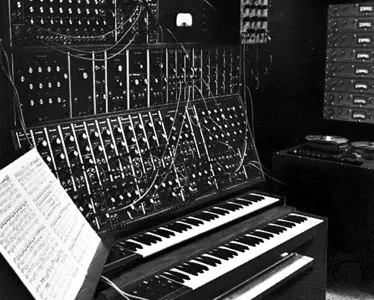
But take a break and watch a few videos of people playing analog synths like >this< and >this<. Don’t you think there’s something special about these machines? Some kind of soul? A kind of beauty that we’ve slowly lost as we moved everything into a computer?
Well, that’s how I feel.
And since this is my blog, I decided I’m going to build a fully analog synthesizer: no computers, no microcontrollers, and no digital signal processing of any kind. Just transistors, op-amps, capacitors, and resistors.
- Will it sound better than a software synth? Probably not, so what?
- Will it be more expensive and harder to build? Absolutely, but we are here to fuck around and find out.
- Will it be fun? I hope so.
i want it modular
The goal is to build it modular. Instead of one big synth with a keyboard, it will be composed of many independent modules, each responsible for a specific task. Some modules will generate signals, others will modify them, others will control them.By connecting them with patch cables, we can create entirely different instruments and sounds.
You can think about it as a big analog signal processing pipeline from hell ;)
A very basic signal path looks something like this:
[Clock Generator]
  │
  ▼
[8-Step Sequencer]
  │
  ▼
[VCO] ─────► [VCF] ─────► [VCA] ─────► [MIXER] ─────► [Delay/Reverb] ─────► [OUTPUT]
                            ▲
                            │
                          [ADSR]
Here’s what those scary acronyms mean:
- Sequencer — Generates notes (pitch and timing).
- VCO (Voltage Controlled Oscillator) — Generates the raw waveform (saw, square, triangle, sine).
- VCF (Voltage Controlled Filter) — Shapes the sound by removing or emphasizing frequencies.
- VCA (Voltage Controlled Amplifier) — Controls the volume of the signal.
- Envelope Generator (ADSR) — Controls how the sound evolves over time (attack, decay, sustain, release).
Of course, this is just the tip of the iceberg. Modular synths can become much more complicated than this. You can route modules in unexpected ways, create feedback loops, modulate almost anything with almost anything else, and quickly end up with a patch that nobody (including yourself) fully understands anymore.
And that’s part of the fun lol.
Over the next posts, we’ll build these modules one by one, starting from the very basics and eventually assembling them into a complete analog synthesizer.
My ultimate goal is to play nightcall.